What Does Productivity Really Mean?
Productivity is a term often bandied about in the modern workplace, but what does it truly signify? At its core, productivity refers to the efficiency with which an individual or organization produces output. It’s not simply about being busy; it’s about achieving meaningful results with the resources available. In a world saturated with distractions and demands, understanding and optimizing productivity has become paramount for both personal and professional success. This involves not just working harder, but working smarter, employing strategies that maximize output while minimizing wasted effort.
What is Deep Work?
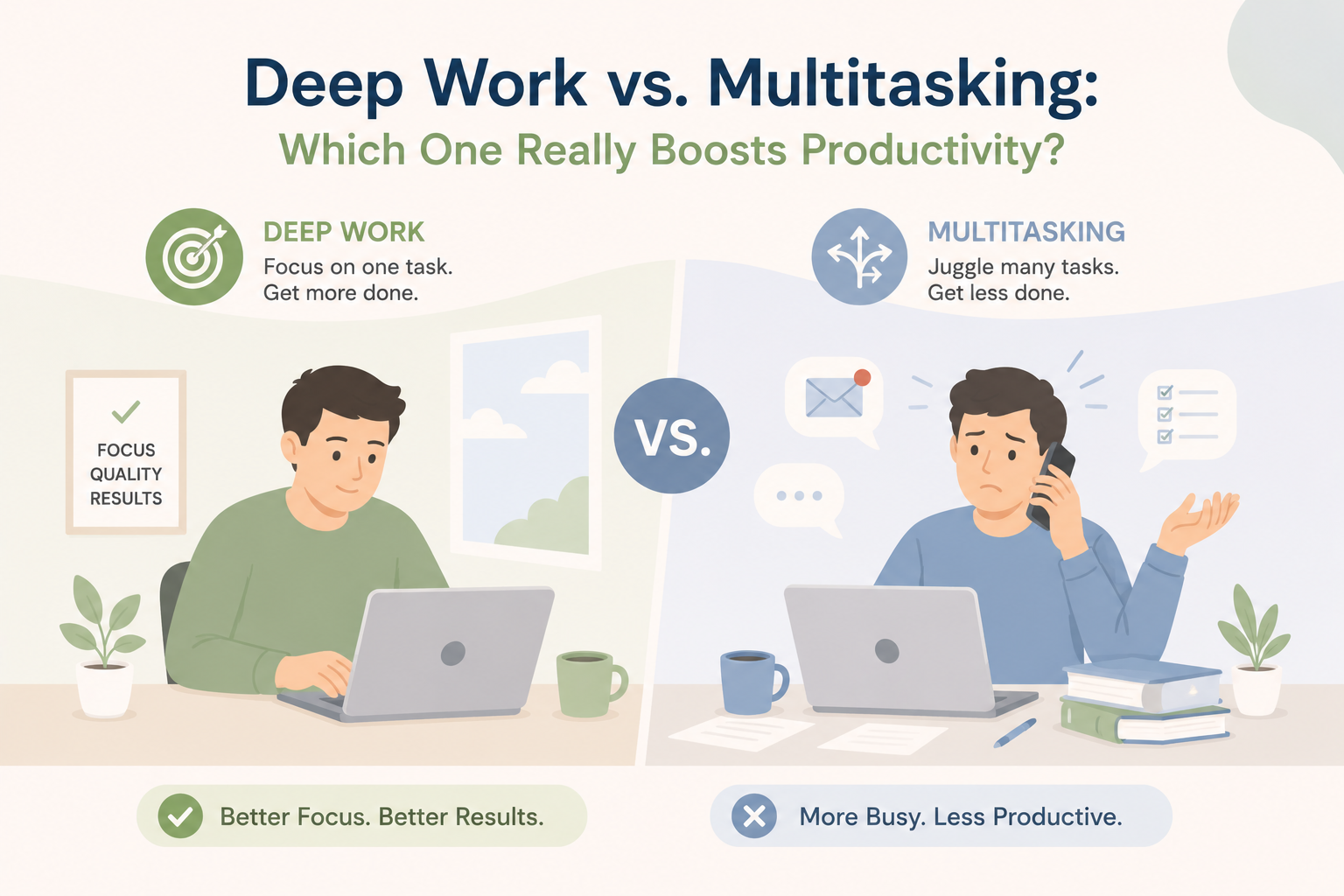
Deep Work, a concept popularized by author Cal Newport, describes professional activities performed in a state of distraction-free concentration that push your cognitive capabilities to their limit. These efforts create new value, improve your skill, and are hard to replicate. It is characterized by intense focus, the absence of interruptions, and a commitment to sustained attention on a single, cognitively demanding task. This deliberate practice allows for the development of complex skills, the creation of novel ideas, and the production of high-quality work that is often difficult to achieve through superficial engagement.
What is Multitasking?
Multitasking, in contrast, is the act of performing multiple tasks or activities simultaneously. In the context of work, this often manifests as switching rapidly between different projects, checking emails while on a call, or responding to instant messages during focused work periods. While it might feel like you’re accomplishing more by juggling several things at once, research consistently shows that true simultaneous cognitive processing is largely a myth. Instead, what we perceive as multitasking is typically rapid task-switching, which incurs a cognitive cost.
Why Multitasking Hurts Focus
The allure of multitasking is understandable; in a fast-paced environment, it can feel like the only way to keep up. However, the reality is that this constant switching exacts a significant toll on our cognitive resources. Each time you shift your attention from one task to another, your brain needs to reorient itself, disengage from the previous task, and re-engage with the new one. This mental “context switching” is inefficient and leads to a loss of momentum. Furthermore, the fragmented attention inherent in multitasking can impair the ability to think critically, solve complex problems, and retain information, ultimately diminishing the quality of work produced and increasing the likelihood of errors.
When Multitasking Actually Makes Sense
While generally detrimental to deep cognitive tasks, there are specific scenarios where multitasking can be effective, or at least not actively harmful. These situations typically involve tasks that are either highly automated, require minimal cognitive load, or are a natural part of a workflow. For instance, listening to a podcast or audiobook while performing a repetitive physical task like folding laundry or going for a run is a form of multitasking that can enhance enjoyment or utilize downtime. In a professional setting, responding to a quick, non-demanding IM while waiting for a document to load or during a brief lull in a conversation might be acceptable. However, it’s crucial to distinguish these low-stakes multitasking activities from those that require focused intellectual effort.
FAQ
Q: Is multitasking ever truly productive?
A: True simultaneous cognitive multitasking is largely a myth. While some low-demand activities can be combined, for cognitively demanding tasks, multitasking reduces efficiency and quality.
Q: How can I start practicing Deep Work?
A: Begin by scheduling dedicated blocks of time for focused work, free from distractions. Gradually increase these blocks and experiment with different environments and techniques to find what works best for you.
Q: What are the key benefits of Deep Work?
A: Deep Work leads to higher quality output, faster skill acquisition, increased creativity, and a greater sense of accomplishment and fulfillment.
Q: If I’m not doing Deep Work, what am I doing?
A: You are likely engaging in “Shallow Work,” which includes tasks that are less cognitively demanding, often logistical in nature, and don’t push your abilities.
Q: How can I improve productivity in general?
A: Focus on identifying your most important tasks, minimizing distractions, practicing Deep Work, and strategically managing your energy and time.
Conclusion
In the ongoing debate between Deep Work and multitasking, the evidence overwhelmingly favors the former for achieving true productivity and mastery. While multitasking might offer the illusion of busyness, it often leads to fragmented attention, reduced quality, and increased errors. Deep Work, conversely, cultivates focus, enhances cognitive abilities, and allows for the creation of valuable, high-impact work. By understanding the distinct nature of these approaches and consciously choosing to prioritize focused, distraction-free engagement for cognitively demanding tasks, individuals can significantly boost their productivity, improve their skills, and achieve more meaningful outcomes.
Sources
Newport, C. (2016). Deep Work: Rules for Focused Success in a Distracted World. Grand Central Publishing.
Ophir, E., Nass, C., & Wagner, A. D. (2009). Cognitive consequences of habitual intensive media multitasking during }long-term learning. Proceedings of the National Academy of Sciences, 106(46), 17546-17551.
Meyer, D. E., & Kieras, D. E. (1997). A computational theory of executive cognitive processes and multiple-task performance: Part 1. Basic mechanisms. Psychological Review, 104(1), 3-65.

Founder and writer of Wex Insights. Joshua Brillante publishes practical, research-based articles on personal finance, productivity, leadership, and personal development. As Wex Insights continues to grow, he also shares travel insights that encourage lifelong learning, better decision-making, and meaningful personal growth. Learn more about the author